ΑΡΙΘΜΗΤΙΚΑ
La Aritmética de Diofanto de AlejandríaThe Arithmetica of Diophantus of Alexandria
Hacia el siglo III, en Alejandría, Diofanto reunió trece libros de problemas sobre números y los resolvió nombrando una incógnita, el arithmós, y escribiendo sus potencias con signos abreviados: es el álgebra más antigua que se conserva. Aquí están los diez libros que han llegado hasta nosotros, seis en griego y cuatro en árabe, con sus 290 problemas uno a uno.
La web quiere ser también una introducción a la teoría de números a través de la obra en la que nace: cada problema va acompañado de la resolución de Diofanto, de su formulación y su solución modernas, y de la curva o superficie que esconde; y la lectura que Fermat hizo de la Aritmética, con sus 48 observaciones al margen, une los problemas de Diofanto con los grandes teoremas y conjeturas de los siglos siguientes. Cómo está organizada.
Around the third century, in Alexandria, Diophantus gathered thirteen books of problems about numbers and solved them by naming an unknown, the arithmos, and writing its powers with abbreviated signs: it is the oldest algebra that survives. Here are the ten books that have come down to us, six in Greek and four in Arabic, with their 290 problems one by one.
The site also aims to be an introduction to number theory through the work in which it was born: each problem comes with Diophantus’s solution, its modern formulation and solution, and the curve or surface hidden in it; and Fermat’s reading of the Arithmetica, with his 48 marginal observations, links Diophantus’s problems to the great theorems and conjectures of the following centuries. How the site is organized.
Un problema al azarA random problem El problema de Fermat, II.8Fermat’s problem, II.8 Las 48 observaciones de FermatFermat’s 48 observations
Los trece libros en su orden original. Se conservan diez: tres al principio y tres al final en griego, cuatro en medio en la traducción árabe; los tres últimos se perdieron.
The thirteen books in their original order. Ten survive: three at the beginning and three at the end in Greek, four in the middle in the Arabic translation; the last three are lost.
De la vida de Diofanto apenas sabemos lo que cuenta el epigrama de la Antología Palatina: fue niño una sexta parte de su vida, joven una doceava, se casó una séptima parte después, tuvo un hijo cinco años más tarde, el hijo vivió la mitad que el padre y Diofanto murió cuatro años después. Resuelto el problema, vivió 84 años.
Of Diophantus’s life we know little more than the epigram in the Palatine Anthology tells: he was a boy for a sixth of his life, a youth for a twelfth, married a seventh later, had a son five years after that, the son lived half as long as his father, and Diophantus died four years later. Solve the problem and he lived 84 years.
Cómo está organizada la webHow the site is organized
Los librosThe books
Cada libro tiene su página, con los problemas en el orden de las ediciones: el enunciado, los datos y la resolución de Diofanto paso a paso, incluidos los intentos que descarta. Un índice lateral, con numerales griegos o arábigos, lleva a cada problema; los más célebres traen un comentario histórico, y los que Fermat anotó, el enlace a su observación.
Each book has its own page, with the problems in the order of the editions: the statement, the data and Diophantus’s solution step by step, including the attempts he discards. A side index, in Greek or Arabic numerals, leads to each problem; the most famous ones carry a historical commentary, and those Fermat annotated, a link to his observation.
Tres vistas de cada problemaThree views of each problem
Ocultar soluciones deja solo los enunciados, para intentarlos antes de leer a Diofanto. Mostrar ecuaciones añade al lado la formulación moderna, la solución algebraica y una celda de SageMath que reproduce la respuesta y se puede modificar. Mostrar geometría dice qué variedad define el problema, su dimensión y su género, una parametrización si es racional y, si es una curva elíptica, su grupo de Mordell–Weil y su ficha en la LMFDB, con código en Sage y en Magma. Los botones siguen a mano al bajar por la página, y cada libro se puede imprimir o guardar en PDF.
Hide solutions leaves only the statements, so you can try them before reading Diophantus. Show equations adds alongside the modern formulation, the algebraic solution and a SageMath cell that reproduces the answer and can be modified. Show geometry tells which variety the problem defines, its dimension and genus, a parametrization when it is rational and, for an elliptic curve, its Mordell–Weil group and its LMFDB entry, with code in Sage and Magma. The buttons stay at hand as you scroll, and each book can be printed or saved as PDF.
BuscarSearch
Por número (II.8, IVa.17), por palabras («cubo», «triángulo rectángulo») o con filtros por libro, por tipo de geometría o por los que tienen comentario histórico. También hay un botón que lleva a un problema al azar.
By number (II.8, IVa.17), by words (“cube”, “right triangle”) or with filters by book, by type of geometry or by those with a historical commentary. There is also a button that takes you to a random problem.
La notación de DiofantoDiophantus’s notation
Los signos con los que escribe la incógnita, sus potencias, la resta y la igualdad, con ejemplos leídos en notación moderna.
The signs with which he writes the unknown, its powers, subtraction and equality, with examples read in modern notation.
Las curvasThe curves
Las 19 curvas elípticas que aparecen en la obra, con su jacobiano, su grupo de puntos racionales y su etiqueta en la LMFDB, y las dos curvas de género 2: la de VIa.17, cuyos puntos se conocen todos, y la de IV.18, un problema abierto.
The 19 elliptic curves that appear in the work, with their Jacobian, their group of rational points and their LMFDB label, and the two curves of genus 2: that of VIa.17, all of whose points are known, and that of IV.18, an open problem.
Las observaciones de FermatFermat’s observations
Las 48 notas que Fermat escribió en su ejemplar de la edición de Bachet: qué dice cada una, a qué problema se refiere, quién demostró después su teorema y el texto latino completo.
The 48 notes Fermat wrote in his copy of Bachet’s edition: what each says, which problem it refers to, who later proved its theorem, and the full Latin text.
La Aritmética en la teoría de númerosThe Arithmetica in number theory
Doce hilos que van de Diofanto a la matemática actual, del último teorema de Fermat y las sumas de cuadrados a los números congruentes, las curvas de Mordell o el décimo problema de Hilbert, con quién los propuso, quién los resolvió y las referencias.
Twelve threads running from Diophantus to current mathematics, from Fermat’s Last Theorem and sums of squares to congruent numbers, Mordell curves or Hilbert’s tenth problem, with who posed them, who solved them and the references.
Ediciones, portadas y bibliografíaEditions, title pages and bibliography
Las ediciones y traducciones de la obra desde 1575, con enlaces a las digitalizadas, las portadas de las principales y una bibliografía de estudios sobre Diofanto y su legado.
The editions and translations of the work since 1575, with links to the digitized ones, the title pages of the main ones and a bibliography of studies on Diophantus and his legacy.
La numeración de los problemas es la de Tannery para los libros griegos y la de Sesiano para los árabes. Las resoluciones siguen las ediciones de Tannery y Heath y la traducción de Christianidis y Oaks (2023), y las respuestas de Diofanto se han verificado con el código de cada problema, que se ha ejecutado completo en SageMath (389 celdas, todas correctas). La web está en inglés y en castellano (botón EN/ES) y tiene modo nocturno; para correcciones y sugerencias hay un buzón al pie de cada página.
Problems are numbered following Tannery for the Greek books and Sesiano for the Arabic ones. The solutions follow the editions of Tannery and Heath and the translation of Christianidis and Oaks (2023), and Diophantus’s answers have been verified with the code of each problem, which has been run in full in SageMath (389 cells, all correct). The site is in English and Spanish (EN/ES button) and has a dark mode; for corrections and suggestions there is a box at the foot of every page.
Buscar un problemaFind a problem
La notación de Diofanto
La Aritmética es el primer texto conservado que nombra una incógnita y escribe sus potencias con signos abreviados. Diofanto llama a la incógnita «número» (arithmós) y a sus potencias por su nombre geométrico o por composición de nombres; en los manuscritos esas palabras aparecen abreviadas.
| Signo | Palabra griega | Significado | Hoy |
|---|---|---|---|
| ς | ἀριθμός, arithmós | el número buscado, la incógnita | x |
| ΔΥ | δύναμις, dýnamis | su cuadrado («potencia») | x² |
| ΚΥ | κύβος, kýbos | su cubo | x³ |
| ΔΥΔ | δυναμοδύναμις | cuadrado del cuadrado | x⁴ |
| ΔΚΥ | δυναμόκυβος | cuadrado por cubo | x⁵ |
| ΚΥΚ | κυβόκυβος | cubo del cubo | x⁶ |
| Μο | μονάδες, monádes | las unidades: el término numérico | 1 |
| ςχ, ΔΥχ | ἀριθμοστόν, δυναμοστόν | las partes recíprocas de la incógnita y de su cuadrado | 1/x, 1/x² |
| ⋔ | λεῖψις, léipsis | «falta»: resta; todo lo que se resta va agrupado detrás | − |
| ἴσ. | ἴσοι, ísoi | «son iguales»: separa los dos miembros | = |
Las reglas para escribir una expresión son tres: los términos se suman poniéndolos uno junto a otro, sin signo; cada potencia va seguida de su coeficiente, escrito con las letras-número griegas (α = 1, β = 2, …, ι = 10, κ = 20, …, ρ = 100, de modo que ις = 16); y todos los términos que se restan se agrupan al final, detrás del signo ⋔. Las fracciones se escriben de varias maneras, por ejemplo con la expresión ἐν μορίῳ («en la parte de»).
Por ejemplo,
ΚΥ α ς η ⋔ ΔΥ ε Μο α
que hoy escribimos x³ − 5x² + 8x − 1: el cubo y las ocho incógnitas se suman, y el cuadrado quíntuple y la unidad se restan. La ecuación del problema II.8, la de la portada, es
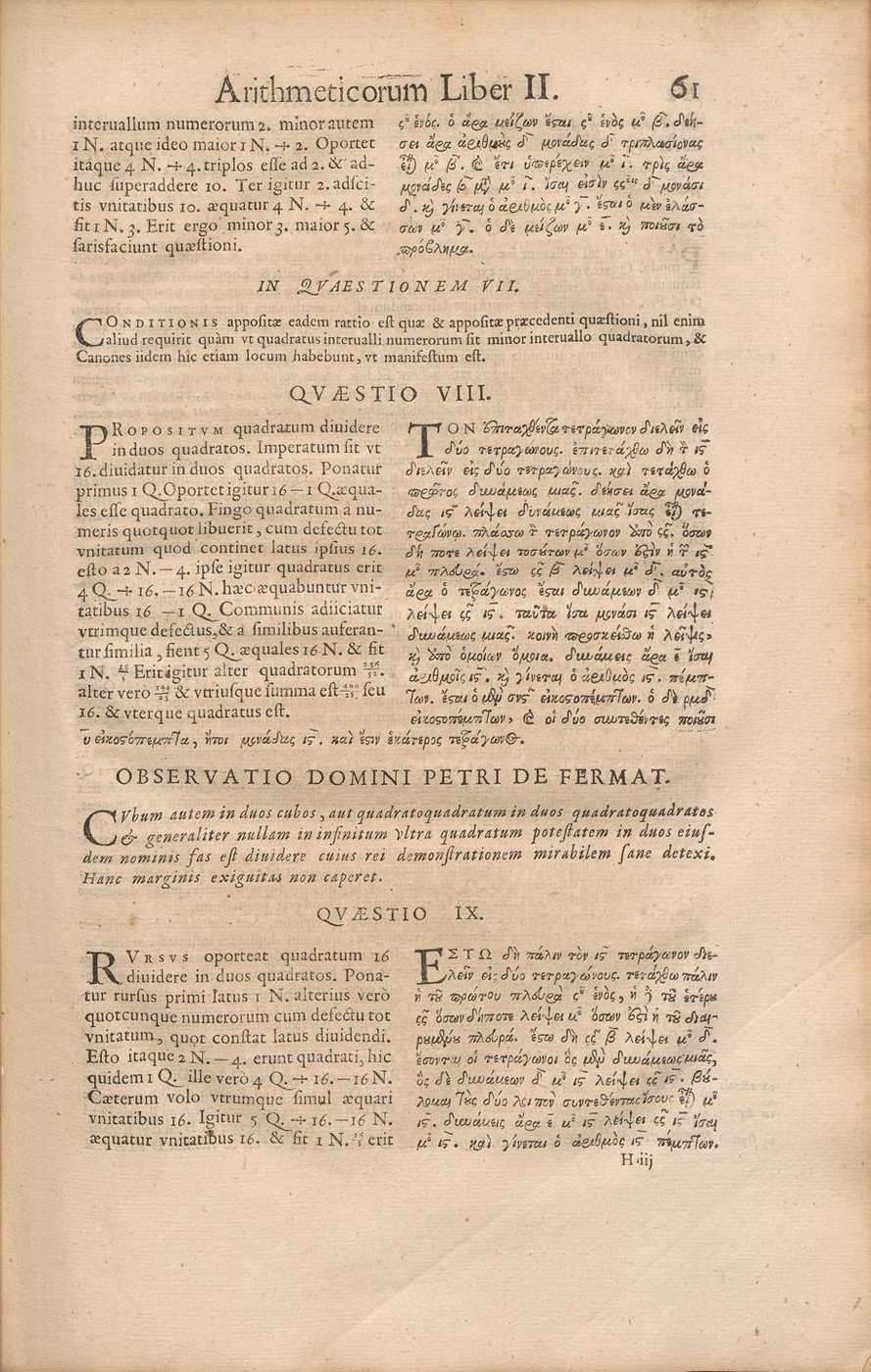
ΔΥ δ Μο ις ⋔ ς ις ἴσ. Μο ις ⋔ ΔΥ α
es decir, 4x² + 16 − 16x = 16 − x².
Estos signos nos llegan a través de manuscritos bizantinos muy posteriores a Diofanto, y su forma varía de uno a otro; los estudios recientes, como los de Christianidis y Oaks, los leen más como abreviaturas de palabras que como símbolos en el sentido moderno. Los libros árabes no usan signos: todo se escribe con palabras, la «cosa» (shayʾ), el māl y el «cubo» (kaʿb).
Diophantus’s notation
The Arithmetica is the earliest surviving text that names an unknown and writes its powers with abbreviated signs. Diophantus calls the unknown “number” (arithmos) and its powers by their geometric names or by combinations of names; in the manuscripts these words appear abbreviated.
| Sign | Greek word | Meaning | Today |
|---|---|---|---|
| ς | ἀριθμός, arithmós | the number sought, the unknown | x |
| ΔΥ | δύναμις, dýnamis | its square (“power”) | x² |
| ΚΥ | κύβος, kýbos | its cube | x³ |
| ΔΥΔ | δυναμοδύναμις | square of the square | x⁴ |
| ΔΚΥ | δυναμόκυβος | square times cube | x⁵ |
| ΚΥΚ | κυβόκυβος | cube of the cube | x⁶ |
| Μο | μονάδες, monádes | the units: the numerical term | 1 |
| ςχ, ΔΥχ | ἀριθμοστόν, δυναμοστόν | the reciprocal parts of the unknown and of its square | 1/x, 1/x² |
| ⋔ | λεῖψις, léipsis | “lack”: subtraction; everything subtracted is grouped after it | − |
| ἴσ. | ἴσοι, ísoi | “are equal”: separates the two sides | = |
There are three rules for writing an expression: terms are added by placing them side by side, with no sign; each power is followed by its coefficient, written with the Greek letter-numerals (α = 1, β = 2, …, ι = 10, κ = 20, …, ρ = 100, so that ις = 16); and all the terms that are subtracted are grouped at the end, after the sign ⋔. Fractions are written in several ways, for instance with the phrase ἐν μορίῳ (“in the part of”).
For example,
ΚΥ α ς η ⋔ ΔΥ ε Μο α
which we write today as x³ − 5x² + 8x − 1: the cube and the eight unknowns are added, and the five squares and the unit are subtracted. The equation of problem II.8, the one on the front page, is
ΔΥ δ Μο ις ⋔ ς ις ἴσ. Μο ις ⋔ ΔΥ α
that is, 4x² + 16 − 16x = 16 − x².
These signs reach us through Byzantine manuscripts written long after Diophantus, and their form varies from one to another; recent studies, such as those of Christianidis and Oaks, read them as abbreviations of words rather than as symbols in the modern sense. The Arabic books use no signs: everything is written in words, the “thing” (shayʾ), the māl and the “cube” (kaʿb).
Portadas de las ediciones
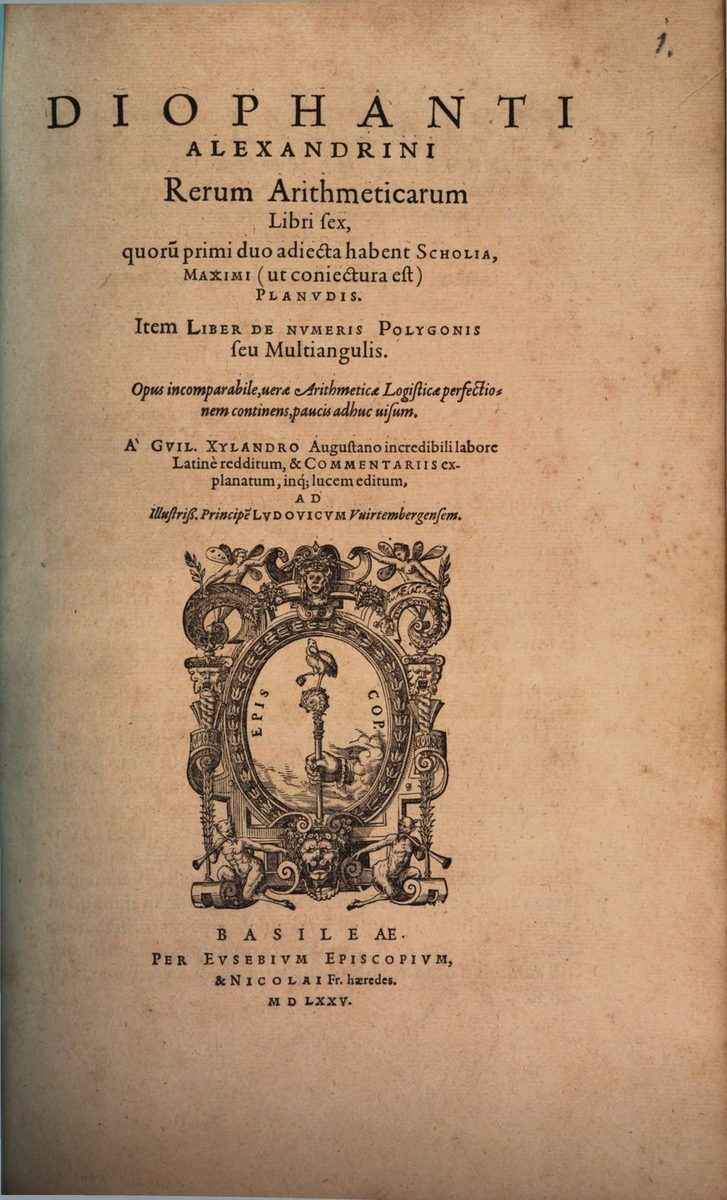
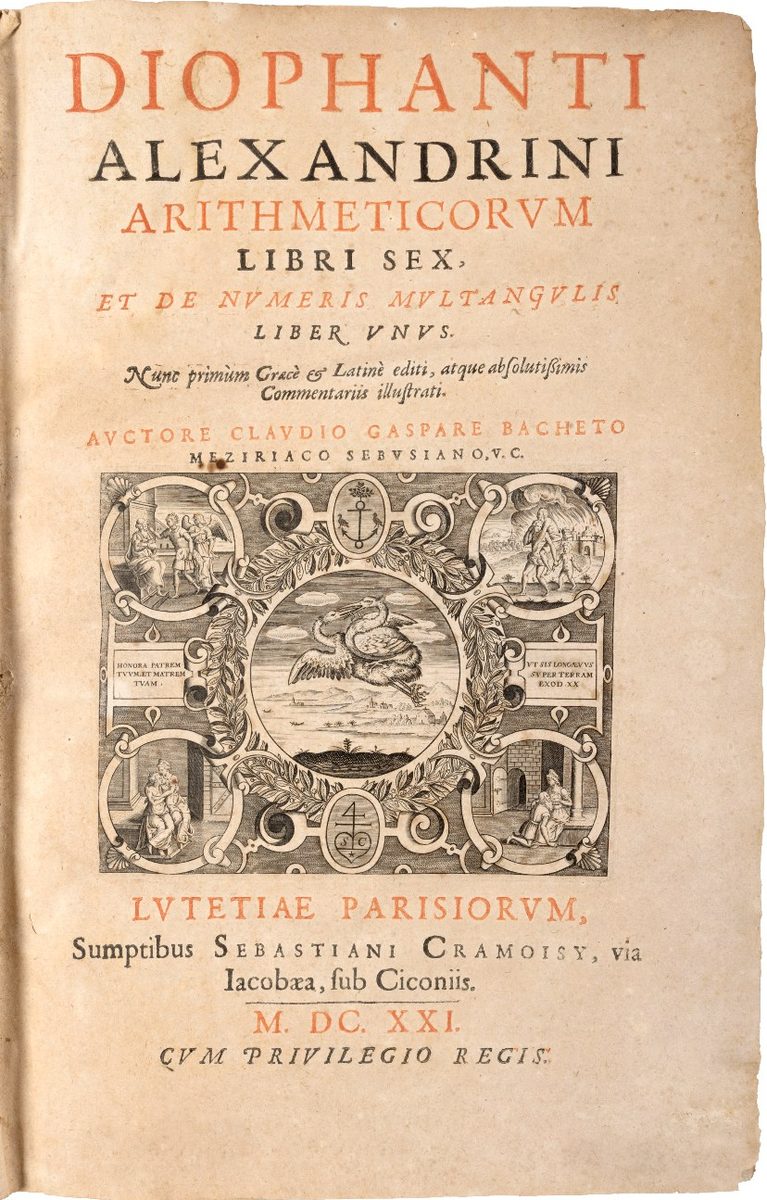
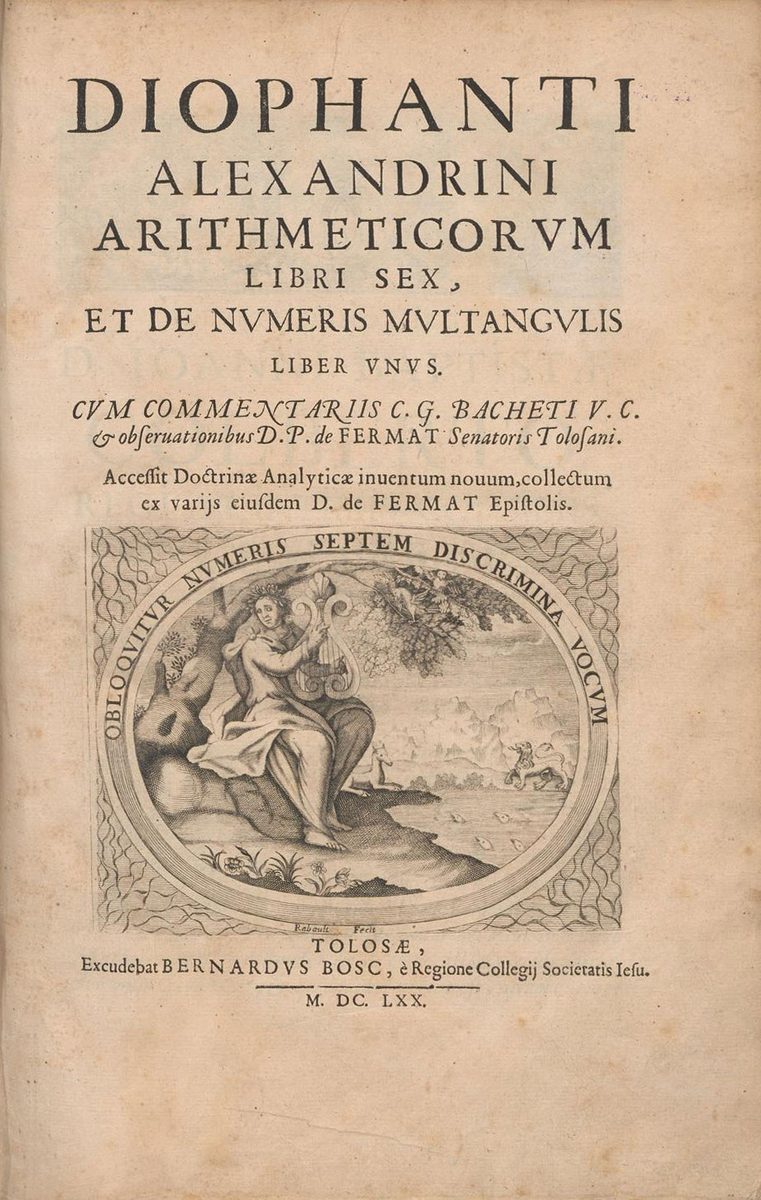
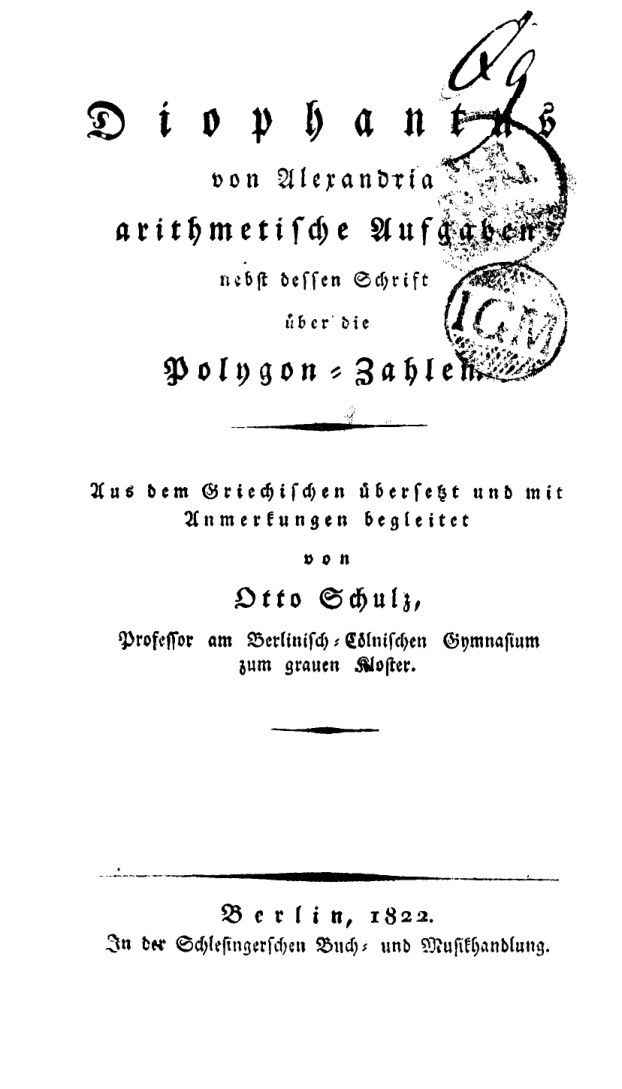
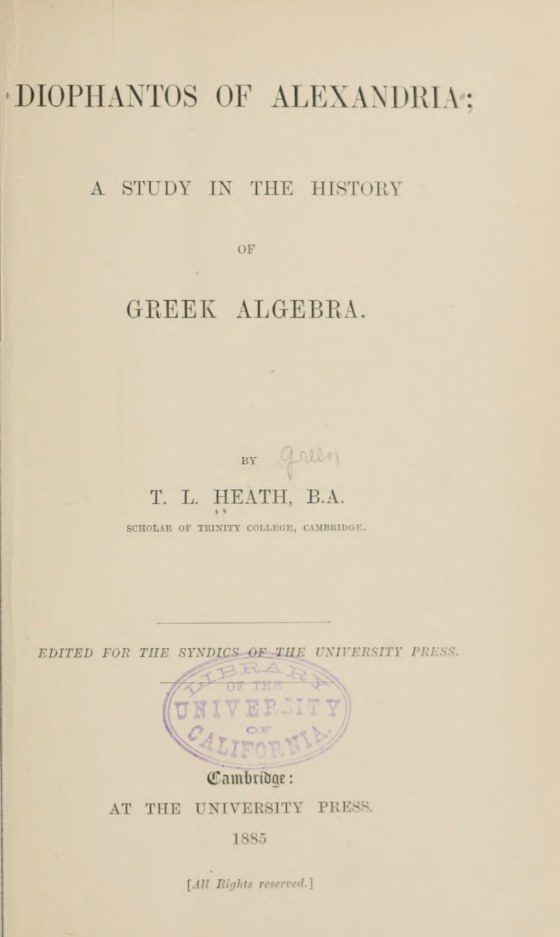
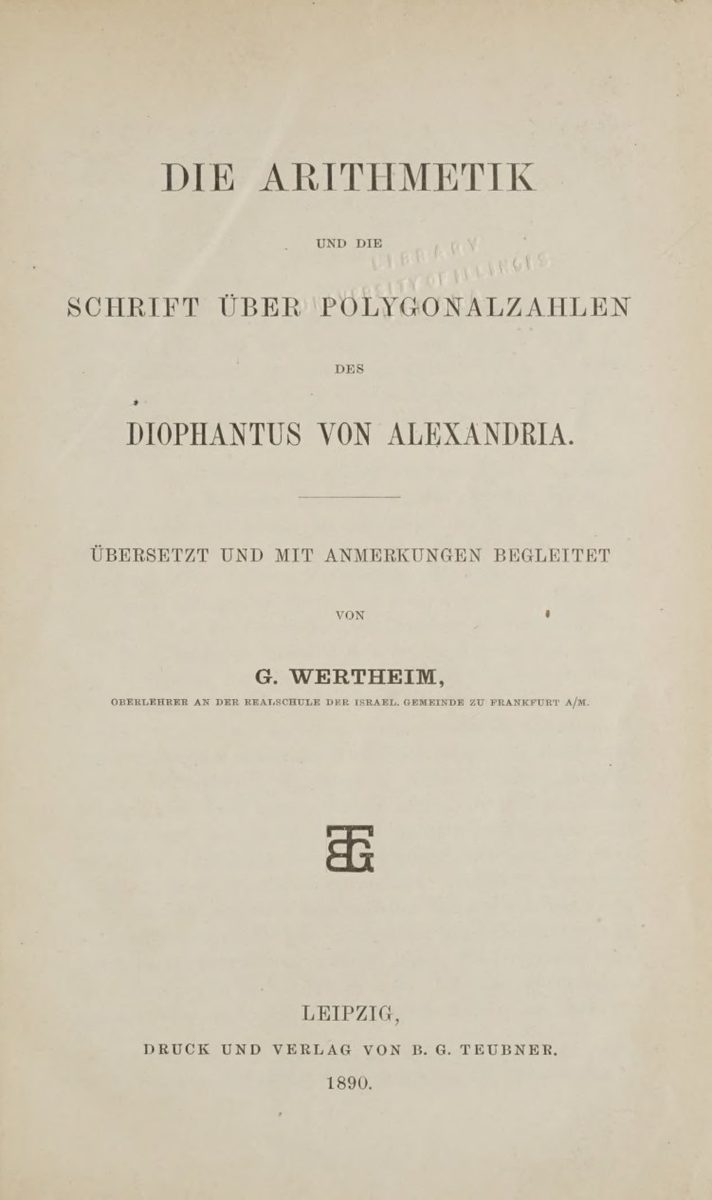
Portadas de las ediciones y traducciones principales, de Xylander (1575) a Heath (1910), todas de dominio público, y la página 61 de la edición de 1670 con el problema II.8 y la observación de Fermat.
Title pages of the editions
Title pages of the main editions and translations, from Xylander (1575) to Heath (1910), all in the public domain, and page 61 of the 1670 edition with problem II.8 and Fermat’s observation.
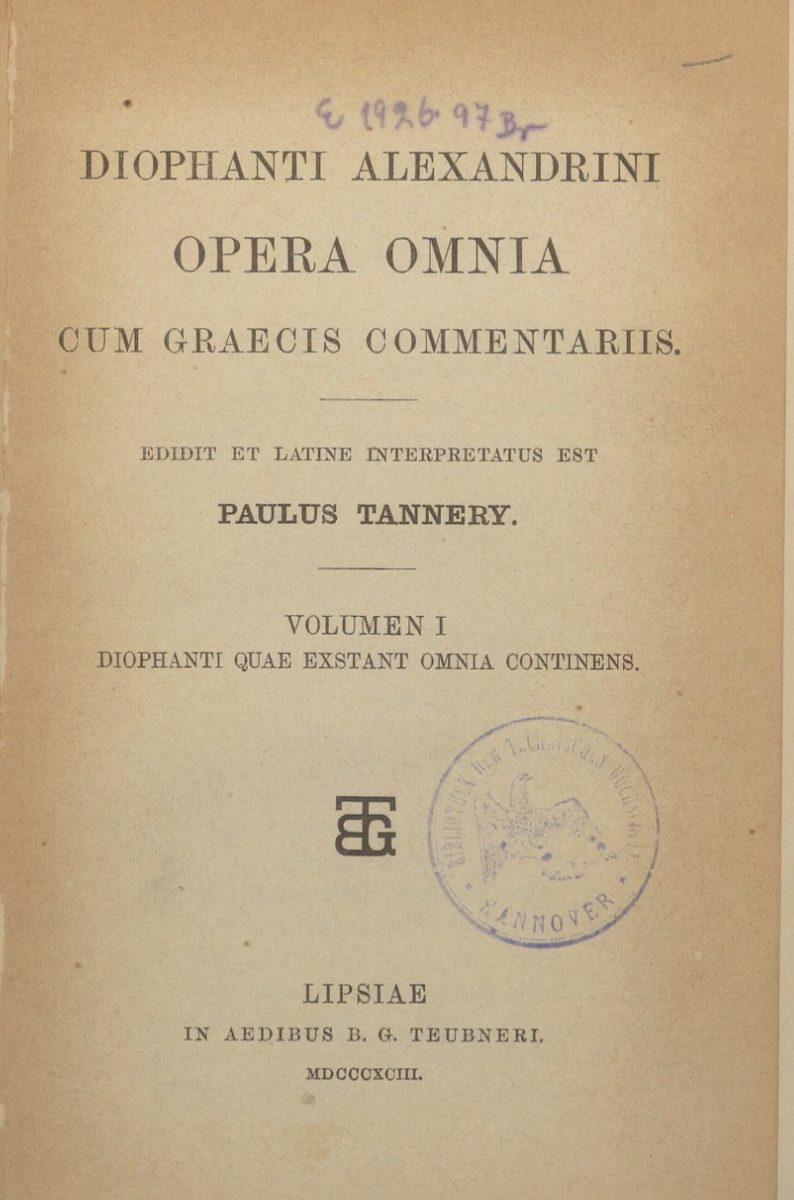
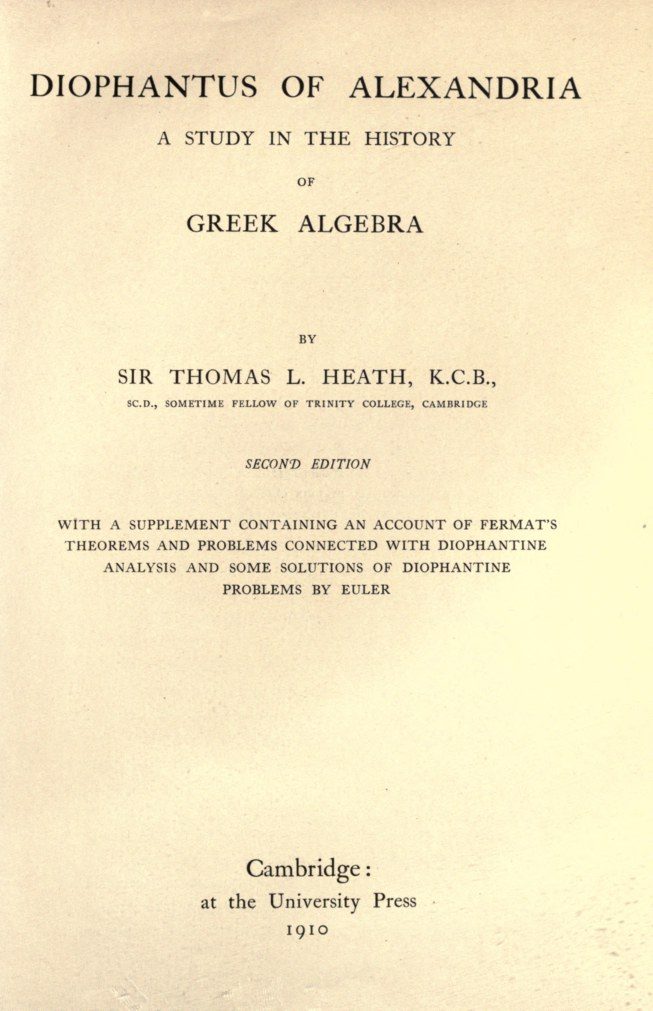
Los libros
Los seis libros griegos siguen la numeración de Tannery y Heath. Los cuatro libros árabes, traducidos por Qusta ibn Luqa en el siglo IX, se intercalan entre el III y el IV griegos; siguen la numeración de Sesiano.
The books
The six Greek books follow the numbering of Tannery and Heath. The four Arabic books, translated by Qusta ibn Luqa in the ninth century, fall between Greek Books III and IV; they follow Sesiano’s numbering.
Las curvas de la Aritmética
Casi todos los problemas de Diofanto definen variedades racionales (puntos, cónicas, superficies cuádricas), y su método consiste en cortarlas con rectas y cónicas hasta dar con un punto racional. En algunos problemas, sin embargo, aparece una curva de género 1 o 2.
Curvas elípticas
En doce problemas, la curva que le queda a Diofanto tras sus elecciones es de género 1: una curva elíptica, donde su doble ecuación o su «tangente en el infinito» encuentran un punto racional. Otras siete están en el fondo de un problema aunque Diofanto no trabaje sobre ellas: las cúbicas x³ ± y³ = b de IV.1–2 y Va.7–8, que él corta con una recta; las curvas de los números congruentes de III.7 y V.7; y la cuártica de VIa.17. La tabla da para cada una el modelo de Weierstrass mínimo de su jacobiano, el grupo de Mordell–Weil (calculado con PARI: ellfromeqn, ellminimalmodel, ellrank) y su etiqueta en la LMFDB, tomada de las tablas de Cremona; las de conductor mayor que 500000 no tienen etiqueta porque la base de datos no llega a ellas.
| Problema | Curva | Jacobiano (modelo mínimo) | E(Q) | Punto de Diofanto | LMFDB |
|---|---|---|---|---|---|
| III.7 | y² = x³ − 720²x tres cuadrados en progresión aritmética de diferencia 720 = 5 · 12²: la curva del número congruente 5 | y² = x³ − 25x | Z × Z/2 × Z/2 | (1681, 62279): los cuadrados 31², 41², 49² | 800.d3 |
| IV.1 | x³ + y³ = 370 la recta x + y = 10 que impone Diofanto la corta solo en dos puntos | y² = x³ − 924075 | Z2 | (7, 3) | buscar por coeficientes sin etiqueta: conductor > 500000 |
| IV.2 | x³ − y³ = 504 cortada por la recta x − y = 6 | y² + y = x³ − 37 | Z | (8, 2) | 11907.o1 |
| IV.24 | (x − 3)² = 9 + c − c³ las dos condiciones del problema (x₁ + x₂ = 6, x₁x₂ = c³ − c) | y² = x³ − x + 9 | Z2 | x = 26/27, c = 17/9 | 8732.b1 |
| IV.28 | Y² = 9y⁴ − 4y³ + 6y² − 12y + 1 condición auxiliar con los cubos (y ± 1)³ | y² = x³ + 17 | Z2 | y = 9/8 | 10404.f2 |
| V.1 | Y² = (13t/2 − 12)(t² − 12) con el primer extremo fijado en 169/4 | y² = x³ − 555x + 3928 | Z × Z/2 | t = 361/104 | 82368.ch1 |
| V.2 | Y² = (19t/2 + 20)(t² + 20) con el primer extremo fijado en 361/4 | y² = x³ − x² + 1672x + 24102 | Z × Z/2 | t = 41/152 | buscar por coeficientes sin etiqueta: conductor > 500000 |
| V.7 | y² = x³ − 210²x triángulos rectángulos de área 210 (840 = 4 · 210): la curva del número congruente 210 | y² = x³ − 44100x | Z2 × Z/2 × Z/2 | (841/4, 1189/8): el triángulo (20, 21, 29) | buscar por coeficientes sin etiqueta: conductor > 500000 |
| V.29 | Y² = t⁴ + 337 con los cuadrados 16 y 9 fijados | y² = x³ − 1348x | Z2 × Z/2 | t² = 144/25 | buscar por coeficientes sin etiqueta: conductor > 500000 |
| VI.6 | Y² = (14y + 1)(y² + 1) el triángulo auxiliar (1, y) | y² = x³ + x² + 196x + 196 | Z × Z/2 | y = 24/7 | 5516.a2 |
| VI.8 | Y² = (y² + 1)(y² + 14y + 1) el triángulo auxiliar | y² = x³ − x² + 191x + 193 | Z × Z/2 | y = 45/28 | 1344.c4 |
| VI.10 | Y² = y⁴ + 8y³ + 18y² + 12y + 1 discriminante cuadrado para el triángulo (1, y + 1) | y² + y = x³ − x | Z | y = 4/5 | 37.a1 |
| VI.17 | u² + 2 = v³ curva de Mordell y² = x³ − 2: solo un punto entero, el de Diofanto y Fermat | y² = x³ − 2 | Z | (3, 5) | 1728.o3 |
| VI.18 | u³ + 2 = v² curva de Mordell y² = x³ + 2; el punto de Diofanto es el doble del generador | y² = x³ + 2 | Z | (17/4, 71/8) | 1728.n4 |
| VI.22 | Y² = (y + 64)(y² − 6144y + 1048576) con el perímetro fijado en 64 | y² + xy = x³ − 178x − 924 | Z × Z/2 | y = 39424/225 | 706.b1 |
| Va.7 | x³ + y³ = 2240 cortada por la recta x + y = 20 | y² + y = x³ − 8269 | Z | (12, 8) | 33075.be1 |
| Va.8 | x³ − y³ = 2170 cortada por la recta x − y = 10 | y² = x³ − 31785075 | Z2 | (13, 3) | buscar por coeficientes sin etiqueta: conductor > 500000 |
| VIa.11 | u² − 1 = v³ curva de Mordell y² = x³ + 1, de rango 0: por eso el 3 es forzoso | y² = x³ + 1 | Z/6 | (2, 3) | 36.a4 |
| VIa.17 | Y² = t⁴ + t² + t la condición en t = x²; es un cociente de la curva de género 2 de la tabla siguiente | y² = x³ + x² + 1 | Z | (1/4, 9/16) | 248.a1 |
Curvas de género 2
Dos problemas llevan a curvas de género 2, que por el teorema de Faltings solo tienen un número finito de puntos racionales. En la de VIa.17 se conocen todos; la de IV.18, en cambio, está hoy fuera del alcance de los métodos que permiten determinarlos, y el problema de hallar todos sus puntos parece abierto.
| Problema | Curva | Cómo aparece | Jacobiano | Puntos racionales | LMFDB |
|---|---|---|---|---|---|
| IV.18 | y² = x⁶ − 128x³ + x + 4096 | Sección x₂ = 64 − x₁³ de la superficie del problema; y es la raíz de x₂² + x₁. | Rango entre 3 y 5, y rango analítico 3 suponiendo la hipótesis de Riemann generalizada (la conjetura de Birch y Swinnerton-Dyer predice, pues, rango 3). End(J) = Z: el jacobiano no se descompone ni tiene multiplicaciones reales. Como el rango supera al género, no se aplican Chabauty–Coleman (exige rango menor que el género), ni el Chabauty elíptico ni los métodos bielípticos (exigen que J se descomponga), ni el Chabauty cuadrático actual (exige rango igual al género y End(J) mayor que Z). | Conocidos, hasta altura 2000: los dos del infinito, (0, ±64), (4, ±2), (−1/16, ±262143/4096) y el de Diofanto, (1/16, ±262145/4096). Los dos primeros dan soluciones degeneradas (x₁ = 0 o x₂ = 0) y el tercero un número negativo: el de Diofanto es el único útil. Determinar todos los puntos racionales parece ser un problema abierto: un reto natural para la teoría de Chabauty–Kim en profundidad 3 o mayor sobre curvas genéricas, como lo fue la curva de VIa.17 para el Chabauty elíptico en los años noventa. | No está: su discriminante supera 10⁶. |
| VIa.17 | y² = x⁶ + x² + 1 | Los tres cuadrados x², x⁴, x⁸ suman un cuadrado: x⁸ + x⁴ + x² = Y², y dividiendo por x² queda esta curva. | Bielíptica: el jacobiano es isógeno a E₁ × E₂ con E₁: y² = x³ + x + 1 (496.a1) y E₂: y² = x³ + x² + 1 (248.a1), ambas de rango 1; rango 2 y conductor 123008. | Exactamente ocho: los dos del infinito, (0, ±1) y (±1/2, ±9/8). Lo demostró Wetherell en 1997 con el método de Chabauty elíptico, resolviendo así este problema de Diofanto: x = 1/2 es la única solución positiva, la que él encontró. | No está: su discriminante mínimo, −2¹⁴ · 31², supera 10⁶. La única curva de conductor 123008 de la LMFDB, 123008.a.246016.1, es otra: tiene invariantes de Igusa distintos y jacobiano simple. |
No aparece en la obra ninguna curva de género mayor que 2. Las más famosas, las de Fermat xⁿ + yⁿ = 1 con n > 2, de género (n − 1)(n − 2)/2 y sin puntos racionales no triviales, solo están en la nota que Fermat escribió junto a II.8; la circunferencia de Diofanto, x² + y² = 16, es de género 0.
The curves of the Arithmetica
Almost all of Diophantus’s problems define rational varieties (points, conics, quadric surfaces), and his method consists in cutting them with lines and conics until a rational point appears. In some problems, however, a curve of genus 1 or 2 arises.
Elliptic curves
In twelve problems, the curve left to Diophantus after his choices has genus 1: an elliptic curve, where his double equation or his “tangent at infinity” finds a rational point. Seven more lie behind a problem although Diophantus does not work on them: the cubics x³ ± y³ = b of IV.1–2 and Va.7–8, which he cuts with a line; the congruent-number curves of III.7 and V.7; and the quartic of VIa.17. The table gives for each the minimal Weierstrass model of its Jacobian, the Mordell–Weil group (computed with PARI: ellfromeqn, ellminimalmodel, ellrank) and its LMFDB label, taken from Cremona’s tables; those of conductor above 500000 have no label because the database does not reach them.
| Problem | Curve | Jacobian (minimal model) | E(Q) | Diophantus’s point | LMFDB |
|---|---|---|---|---|---|
| III.7 | y² = x³ − 720²x three squares in arithmetic progression with difference 720 = 5 · 12²: the curve of the congruent number 5 | y² = x³ − 25x | Z × Z/2 × Z/2 | (1681, 62279): the squares 31², 41², 49² | 800.d3 |
| IV.1 | x³ + y³ = 370 the line x + y = 10 imposed by Diophantus meets it in two points only | y² = x³ − 924075 | Z2 | (7, 3) | search by coefficients no label: conductor > 500000 |
| IV.2 | x³ − y³ = 504 cut by the line x − y = 6 | y² + y = x³ − 37 | Z | (8, 2) | 11907.o1 |
| IV.24 | (x − 3)² = 9 + c − c³ the two conditions of the problem (x₁ + x₂ = 6, x₁x₂ = c³ − c) | y² = x³ − x + 9 | Z2 | x = 26/27, c = 17/9 | 8732.b1 |
| IV.28 | Y² = 9y⁴ − 4y³ + 6y² − 12y + 1 auxiliary condition with the cubes (y ± 1)³ | y² = x³ + 17 | Z2 | y = 9/8 | 10404.f2 |
| V.1 | Y² = (13t/2 − 12)(t² − 12) with the first extreme fixed at 169/4 | y² = x³ − 555x + 3928 | Z × Z/2 | t = 361/104 | 82368.ch1 |
| V.2 | Y² = (19t/2 + 20)(t² + 20) with the first extreme fixed at 361/4 | y² = x³ − x² + 1672x + 24102 | Z × Z/2 | t = 41/152 | search by coefficients no label: conductor > 500000 |
| V.7 | y² = x³ − 210²x right triangles of area 210 (840 = 4 · 210): the curve of the congruent number 210 | y² = x³ − 44100x | Z2 × Z/2 × Z/2 | (841/4, 1189/8): the triangle (20, 21, 29) | search by coefficients no label: conductor > 500000 |
| V.29 | Y² = t⁴ + 337 with the squares 16 and 9 fixed | y² = x³ − 1348x | Z2 × Z/2 | t² = 144/25 | search by coefficients no label: conductor > 500000 |
| VI.6 | Y² = (14y + 1)(y² + 1) the auxiliary triangle (1, y) | y² = x³ + x² + 196x + 196 | Z × Z/2 | y = 24/7 | 5516.a2 |
| VI.8 | Y² = (y² + 1)(y² + 14y + 1) the auxiliary triangle | y² = x³ − x² + 191x + 193 | Z × Z/2 | y = 45/28 | 1344.c4 |
| VI.10 | Y² = y⁴ + 8y³ + 18y² + 12y + 1 square discriminant for the triangle (1, y + 1) | y² + y = x³ − x | Z | y = 4/5 | 37.a1 |
| VI.17 | u² + 2 = v³ Mordell curve y² = x³ − 2: one integer point only, Diophantus’s and Fermat’s | y² = x³ − 2 | Z | (3, 5) | 1728.o3 |
| VI.18 | u³ + 2 = v² Mordell curve y² = x³ + 2; Diophantus’s point is twice the generator | y² = x³ + 2 | Z | (17/4, 71/8) | 1728.n4 |
| VI.22 | Y² = (y + 64)(y² − 6144y + 1048576) with the perimeter fixed at 64 | y² + xy = x³ − 178x − 924 | Z × Z/2 | y = 39424/225 | 706.b1 |
| Va.7 | x³ + y³ = 2240 cut by the line x + y = 20 | y² + y = x³ − 8269 | Z | (12, 8) | 33075.be1 |
| Va.8 | x³ − y³ = 2170 cut by the line x − y = 10 | y² = x³ − 31785075 | Z2 | (13, 3) | search by coefficients no label: conductor > 500000 |
| VIa.11 | u² − 1 = v³ Mordell curve y² = x³ + 1, of rank 0: hence 3 is forced | y² = x³ + 1 | Z/6 | (2, 3) | 36.a4 |
| VIa.17 | Y² = t⁴ + t² + t the condition in t = x²; it is a quotient of the genus-2 curve in the next table | y² = x³ + x² + 1 | Z | (1/4, 9/16) | 248.a1 |
Curves of genus 2
Two problems lead to curves of genus 2, which by Faltings’s theorem have only finitely many rational points. For that of VIa.17 all are known; that of IV.18, by contrast, is currently beyond the reach of the methods that determine them, and finding all its points appears to be an open problem.
| Problem | Curve | How it arises | Jacobian | Rational points | LMFDB |
|---|---|---|---|---|---|
| IV.18 | y² = x⁶ − 128x³ + x + 4096 | Section x₂ = 64 − x₁³ of the surface of the problem; y is the root of x₂² + x₁. | Rank between 3 and 5, and analytic rank 3 assuming the generalized Riemann hypothesis (so the Birch and Swinnerton-Dyer conjecture predicts rank 3). End(J) = Z: the Jacobian neither splits nor has real multiplication. Since the rank exceeds the genus, none of the following apply: Chabauty–Coleman (requires rank less than the genus), elliptic Chabauty or bielliptic methods (require J to split), or current quadratic Chabauty (requires rank equal to the genus and End(J) larger than Z). | Known, up to height 2000: the two at infinity, (0, ±64), (4, ±2), (−1/16, ±262143/4096) and Diophantus’s, (1/16, ±262145/4096). The first two give degenerate solutions (x₁ = 0 or x₂ = 0) and the third a negative number: Diophantus’s is the only useful one. Determining all the rational points appears to be an open problem: a natural challenge for Chabauty–Kim theory in depth 3 or more on generic curves, as the curve of VIa.17 was for elliptic Chabauty in the 1990s. | Not included: its discriminant exceeds 10⁶. |
| VIa.17 | y² = x⁶ + x² + 1 | The three squares x², x⁴, x⁸ add up to a square: x⁸ + x⁴ + x² = Y², and dividing by x² this curve remains. | Bielliptic: the Jacobian is isogenous to E₁ × E₂ with E₁: y² = x³ + x + 1 (496.a1) and E₂: y² = x³ + x² + 1 (248.a1), both of rank 1; rank 2 and conductor 123008. | Exactly eight: the two at infinity, (0, ±1) and (±1/2, ±9/8). Wetherell proved it in 1997 with the elliptic Chabauty method, thereby solving this problem of Diophantus: x = 1/2 is the only positive solution, the one he found. | Not included: its minimal discriminant, −2¹⁴ · 31², exceeds 10⁶. The only curve of conductor 123008 in the LMFDB, 123008.a.246016.1, is a different one: it has different Igusa invariants and a simple Jacobian. |
No curve of genus greater than 2 appears in the work. The most famous ones, the Fermat curves xⁿ + yⁿ = 1 with n > 2, of genus (n − 1)(n − 2)/2 and with no non-trivial rational points, appear only in the note Fermat wrote beside II.8; Diophantus’s circle, x² + y² = 16, has genus 0.
Ediciones y traducciones
La Aritmética se ha traducido completa a muy pocas lenguas. El texto griego se conserva en una treintena de manuscritos bizantinos, el más antiguo e importante el Matritensis (Madrid, Biblioteca Nacional, Ms. 4678, siglo XI); los libros árabes solo en el manuscrito de Mashhad hallado en 1968.
Latín
- Xylander (Wilhelm Holzmann), Basilea 1575: primera edición impresa, solo la traducción latina, hecha sobre un único manuscrito muy corrupto. Ejemplar digitalizado (Gallica, BnF).
- Rafael Bombelli y Antonio Maria Pazzi, hacia 1570: traducción latina de cinco libros, nunca publicada; Bombelli incorporó 143 problemas a su Algebra (1572).
- Claude-Gaspard Bachet de Méziriac, París 1621: primera edición del texto griego, con traducción latina y comentario. Ejemplar completo digitalizado (ETH-Bibliothek Zúrich, e-rara).
- Samuel de Fermat, Toulouse 1670: reimpresión de Bachet, peor como texto, pero con las observaciones de Pierre de Fermat impresas. Ejemplar completo digitalizado (e-rara); páginas escogidas en MAA Convergence.
- Paul Tannery, Diophanti Alexandrini opera omnia, Leipzig 1893–1895 (Teubner, 2 vols.): edición crítica del griego con traducción latina, escolios y el comentario de Planudes. Sigue siendo la referencia para el texto griego. Volumen II digitalizado.
Francés
- Simon Stevin, L’Arithmétique, Leiden 1585: libros I–IV; Albert Girard añadió los libros V y VI en la reedición de 1625.
- Paul Ver Eecke, Diophante d’Alexandrie. Les six livres arithmétiques et le livre des nombres polygones, Brujas, Desclée de Brouwer, 1926 (reimpresión París, Blanchard, 1959): primera traducción francesa completa de los seis libros griegos y del tratado sobre los números poligonales.
- André Allard, Diophante d’Alexandrie. Les Arithmétiques. Histoire du texte grec, édition critique, traductions et scolies, Lovaina 1980: nueva edición crítica con traducción, tesis doctoral que quedó inédita.
- Roshdi Rashed, Diophante, Les Arithmétiques, tomos III y IV, Les Belles Lettres (Collection des Universités de France), 1984: texto árabe y traducción francesa de los libros IV–VII. Con Christian Houzel publicó en 2013 un comentario completo de toda la obra, Les Arithmétiques de Diophante. Lecture historique et mathématique (De Gruyter, doi:10.1515/9783110336481).
Alemán
- Friedrich Theodor Poselger, 1810: solo los números poligonales.
- Otto Schulz, Diophantus von Alexandria arithmetische Aufgaben nebst dessen Schrift über die Polygon-Zahlen, Berlín 1822: primera traducción completa a una lengua moderna.
- Gustav Wertheim, Die Arithmetik und die Schrift über Polygonalzahlen des Diophantus von Alexandria, Leipzig, Teubner, 1890.
- Arthur Czwalina, Arithmetik des Diophantos aus Alexandria, Gotinga, Vandenhoeck & Ruprecht, 1952.
Inglés
- Thomas L. Heath, Diophantus of Alexandria. A Study in the History of Greek Algebra, Cambridge 1885; 2.ª ed. 1910: no es una traducción literal sino una paráfrasis en notación moderna, pero es la que más ha circulado (reimpresa por Dover en 1964).
- Jacques Sesiano, Books IV to VII of Diophantus’ Arithmetica in the Arabic Translation Attributed to Qusta ibn Luqa, Nueva York, Springer, 1982: edición crítica del texto árabe, traducción inglesa y estudio de las interpolaciones (doi:10.1007/978-1-4613-8174-7).
- Jean Christianidis y Jeffrey Oaks, The Arithmetica of Diophantus. A Complete Translation and Commentary, Routledge 2023: primera traducción de los diez libros conservados, con comentario problema a problema. Es hoy la edición de referencia.
Árabe
- Traducción medieval atribuida a Qusta ibn Luqa (siglo IX), única fuente de los libros IV–VII. Roshdi Rashed publicó el texto árabe en El Cairo en 1975 (L’Art de l’Algèbre de Diophante), antes de su edición francesa.
Griego moderno
- Evangelos Stamatis, Διοφάντου Ἀριθμητικά, Atenas 1963, con el texto antiguo de Tannery enfrentado e incluyendo reconstrucciones de los problemas perdidos.
- Jean Christianidis y Jeffrey Oaks, Τα Αριθμητικά του Διόφαντου, traducción de Jean Christianidis, Crete University Press, 2026: versión griega de su traducción comentada de 2023 (editorial).
Ruso
- Moscú, Nauka, 1974: traducción de I. N. Veselovski con comentario de I. G. Bashmakova; incluye los números poligonales.
Español
- La Aritmética y el libro Sobre los números poligonales, Nivola 2007 (2 vols.): contiene los seis libros griegos y los cuatro árabes; fue la traducción más reciente de Diofanto hasta la inglesa de 2023.
Italiano
- No hay traducción completa. Lo más cercano es la Algebra de Bombelli (1572), que adapta los problemas, y la edición crítica, con traducción y comentario, de Fabio Acerbi del tratado sobre los números poligonales: Diofanto. De polygonis numeris, Pisa–Roma, Fabrizio Serra, 2011.
Neerlandés
- Andreas Meskens y Nico van der Auwera, Diophantos van Alexandrië, Arithmetika, 2006.
Japonés
- Takanori Kusuba y Taro Tokutake, ディオファントス『算術』 アラビア語版 和訳注 (Diophantus’ Arithmetica: An Annotated Japanese Translation of the Arabic Version), Kioto, Gendai Suugakusha, 2025: traducción anotada de los libros árabes IV–VII, basada en la edición de Sesiano (editorial).
De otras lenguas no se conoce traducción completa.
Editions and translations
The Arithmetica has been translated in full into very few languages. The Greek text survives in some thirty Byzantine manuscripts, the oldest and most important being the Matritensis (Madrid, Biblioteca Nacional, MS 4678, eleventh century); the Arabic books survive only in the Mashhad manuscript found in 1968.
Latin
- Xylander (Wilhelm Holzmann), Basel 1575: first printed edition, Latin translation only, made from a single badly corrupt manuscript. Digitized copy (Gallica, BnF).
- Rafael Bombelli and Antonio Maria Pazzi, c. 1570: Latin translation of five books, never published; Bombelli incorporated 143 problems into his Algebra (1572).
- Claude-Gaspard Bachet de Méziriac, Paris 1621: first edition of the Greek text, with Latin translation and commentary. Complete digitized copy (ETH Library Zurich, e-rara).
- Samuel de Fermat, Toulouse 1670: reprint of Bachet, inferior as a text but with Pierre de Fermat’s observations printed. Complete digitized copy (e-rara); selected pages at MAA Convergence.
- Paul Tannery, Diophanti Alexandrini opera omnia, Leipzig 1893–1895 (Teubner, 2 vols.): critical edition of the Greek with Latin translation, scholia and Planudes’s commentary. Still the reference for the Greek text. Volume II digitized.
French
- Simon Stevin, L’Arithmétique, Leiden 1585: Books I–IV; Albert Girard added Books V and VI in the 1625 reissue.
- Paul Ver Eecke, Diophante d’Alexandrie. Les six livres arithmétiques et le livre des nombres polygones, Bruges, Desclée de Brouwer, 1926 (reprinted Paris, Blanchard, 1959): first complete French translation of the six Greek books and the treatise on polygonal numbers.
- André Allard, Diophante d’Alexandrie. Les Arithmétiques. Histoire du texte grec, édition critique, traductions et scolies, Louvain 1980: new critical edition with translation, a doctoral thesis that remained unpublished.
- Roshdi Rashed, Diophante, Les Arithmétiques, vols. III and IV, Les Belles Lettres (Collection des Universités de France), 1984: Arabic text and French translation of Books IV–VII. With Christian Houzel he published in 2013 a complete commentary on the whole work, Les Arithmétiques de Diophante. Lecture historique et mathématique (De Gruyter, doi:10.1515/9783110336481).
German
- Friedrich Theodor Poselger, 1810: polygonal numbers only.
- Otto Schulz, Diophantus von Alexandria arithmetische Aufgaben nebst dessen Schrift über die Polygon-Zahlen, Berlin 1822: first complete translation into a modern language.
- Gustav Wertheim, Die Arithmetik und die Schrift über Polygonalzahlen des Diophantus von Alexandria, Leipzig, Teubner, 1890.
- Arthur Czwalina, Arithmetik des Diophantos aus Alexandria, Göttingen, Vandenhoeck & Ruprecht, 1952.
English
- Thomas L. Heath, Diophantus of Alexandria. A Study in the History of Greek Algebra, Cambridge 1885; 2nd ed. 1910: not a literal translation but a paraphrase in modern notation, yet the most widely circulated (reprinted by Dover in 1964).
- Jacques Sesiano, Books IV to VII of Diophantus’ Arithmetica in the Arabic Translation Attributed to Qusta ibn Luqa, New York, Springer, 1982: critical edition of the Arabic text, English translation and a study of the interpolations (doi:10.1007/978-1-4613-8174-7).
- Jean Christianidis and Jeffrey Oaks, The Arithmetica of Diophantus. A Complete Translation and Commentary, Routledge 2023: first translation of all ten surviving books, with problem-by-problem commentary. Now the standard edition.
Arabic
- Medieval translation attributed to Qusta ibn Luqa (ninth century), the only source for Books IV–VII. Roshdi Rashed published the Arabic text in Cairo in 1975 (L’Art de l’Algèbre de Diophante), before his French edition.
Modern Greek
- Evangelos Stamatis, Διοφάντου Ἀριθμητικά, Athens 1963, with Tannery’s ancient text facing and including reconstructions of the lost problems.
- Jean Christianidis and Jeffrey Oaks, Τα Αριθμητικά του Διόφαντου, translated by Jean Christianidis, Crete University Press, 2026: the Greek version of their annotated translation of 2023 (publisher).
Russian
- Moscow, Nauka, 1974: translation by I. N. Veselovsky with commentary by I. G. Bashmakova; includes the polygonal numbers.
Spanish
- La Aritmética y el libro Sobre los números poligonales, Nivola 2007 (2 vols.): contains the six Greek and the four Arabic books; the most recent translation of Diophantus until the English one of 2023.
Italian
- No complete translation. The closest are Bombelli’s Algebra (1572), which adapts the problems, and Fabio Acerbi’s critical edition, with translation and commentary, of the treatise on polygonal numbers: Diofanto. De polygonis numeris, Pisa–Rome, Fabrizio Serra, 2011.
Dutch
- Andreas Meskens and Nico van der Auwera, Diophantos van Alexandrië, Arithmetika, 2006.
Japanese
- Takanori Kusuba and Taro Tokutake, ディオファントス『算術』 アラビア語版 和訳注 (Diophantus’ Arithmetica: An Annotated Japanese Translation of the Arabic Version), Kyoto, Gendai Suugakusha, 2025: annotated translation of the Arabic Books IV–VII, based on Sesiano’s edition (publisher).
No complete translation into other languages is known.
Bibliografía
Selección de estudios históricos y artículos matemáticos dedicados a Diofanto y a su Aritmética, con los títulos en su lengua original; las ediciones y traducciones de la obra están en la sección Ediciones y traducciones. Esta bibliografía no es exhaustiva: la Aritmética se cita en miles de trabajos, entre ellos casi todos los que tratan de las ecuaciones diofánticas, el último teorema de Fermat, los números congruentes, las ternas y cuádruplas diofánticas, las sumas de cuadrados, los puntos racionales de las curvas elípticas o el décimo problema de Hilbert. Aquí se reúnen los estudios sobre la obra y su transmisión y una muestra de la investigación matemática actual que parte de sus problemas.
1. Estudios sobre Diofanto y su método
Clásicos
- Nesselmann, G. H. F., Die Algebra der Griechen, Berlín, 1842.
- Hankel, H., Zur Geschichte der Mathematik in Alterthum und Mittelalter, Leipzig, 1874.
- Hultsch, F., «Diophantos», en Pauly–Wissowa, Realencyclopädie, V, 1903.
- Klein, J., Greek Mathematical Thought and the Origin of Algebra, MIT Press, 1968 (original alemán 1934–1936).
- Vogel, K., «Diophantus of Alexandria», en Dictionary of Scientific Biography, vol. IV, 1971.
- Bashmakova, I. G., Diophant und diophantische Gleichungen, Basilea, Birkhäuser, 1974 (trad. inglesa Diophantus and Diophantine Equations, MAA, 1997).
- Bashmakova, I. G., «Arithmetic of algebraic curves from Diophantus to Poincaré», Historia Mathematica 8 (1981), 393–416.
- Weil, A., Number Theory: An Approach through History from Hammurapi to Legendre, Birkhäuser, 1984 (cap. I sobre Diofanto; cap. II sobre Fermat).
Artículos recientes
- Knorr, W. R., «Arithmêtikê stoicheiôsis: On Diophantus and Hero of Alexandria», Historia Mathematica 20 (1993), 180–192.
- Christianidis, J., «Arithmêtikê stoicheiôsis: un traité perdu de Diophante d'Alexandrie?», Historia Mathematica 18 (1991), 239–246.
- Christianidis, J., «Maxime Planude sur le sens du terme diophantien plasmatikon», Historia Scientiarum 6 (1996), 37–41.
- Christianidis, J., «Une interprétation byzantine de Diophante», Historia Mathematica 25 (1998), 22–28.
- Christianidis, J., «The way of Diophantus: Some clarifications on Diophantus' method of solution», Historia Mathematica 34 (2007), 289–305.
- Thomaidis, Y., «A framework for defining the generality of Diophantos' methods in Arithmetica», Archive for History of Exact Sciences 59 (2005), 591–640. doi:10.1007/s00407-005-0099-8.
- Thomaidis, Y., «Some remarks on the meaning of equality in Diophantos's Arithmetica», Historia Mathematica 38 (2011), 28–41.
- Acerbi, F., «The meaning of πλασματικόν in Diophantus' Arithmetica», Archive for History of Exact Sciences 63 (2009), 5–31. doi:10.1007/s00407-008-0028-8.
- Acerbi, F., «The language of the “givens”: its forms and its use as a deductive tool in Greek mathematics», Archive for History of Exact Sciences 65 (2011), 119–153.
- Bernard, A., y J. Christianidis, «A new analytical framework for the understanding of Diophantus's Arithmetica I–III», Archive for History of Exact Sciences 66 (2012), 1–69. doi:10.1007/s00407-011-0090-5.
- Netz, R., «Reasoning and symbolism in Diophantus: Preliminary observations», en K. Chemla (ed.), The History of Mathematical Proof in Ancient Traditions, Cambridge University Press, 2012, 327–361.
- Christianidis, J., y J. A. Oaks, «Practicing algebra in late antiquity: The problem-solving of Diophantus of Alexandria», Historia Mathematica 40 (2013), 127–163. doi:10.1016/j.hm.2012.09.001.
- Christianidis, J., e I. Skoura, «Solving problems by algebra in late antiquity: New evidence from an unpublished fragment of Theon's commentary on the Almagest», SCIAMVS 14 (2013), 41–57.
- Christianidis, J., «The meaning of hypostasis in Diophantus' Arithmetica», en T. Arabatzis, J. Renn y A. Simões (eds.), Relocating the History of Science, Springer, 2015, 315–327.
- Sialaros, M., y J. Christianidis, «Situating the debate on “geometrical algebra” within the framework of premodern algebra», Science in Context 29 (2016), 129–150.
- Christianidis, J., «Diophantus and premodern algebra: New light on an old image», en M. Sialaros (ed.), Revolutions and Continuity in Greek Mathematics, Berlín, De Gruyter, 2018, 35–65.
- Oaks, J. A., «Diophantus, al-Karajī, and quadratic equations», en M. Sialaros (ed.), Revolutions and Continuity in Greek Mathematics, De Gruyter, 2018, 271–294.
- Christianidis, J., y A. Megremi, «Tracing the early history of algebra: Testimonies on Diophantus in the Greek-speaking world (4th–7th century CE)», Historia Mathematica 47 (2019), 16–38. doi:10.1016/j.hm.2019.02.002.
- Christianidis, J., «Analytical reasoning and problem-solving in Diophantus's Arithmetica: Two different styles of reasoning in Greek mathematics», Philosophia Scientiæ 25 (3) (2021), 103–130.
- Christianidis, J., «Rhetoric of mathematics: The case of Diophantus of Alexandria», en S. Papaioannou, A. Serafim y M. J. Edwards (eds.), Brill's Companion to the Reception of Ancient Rhetoric, Leiden, Brill, 617–642.
- Christianidis, J., y J. A. Oaks, «Diophantus», Oxford Research Encyclopedia / Oxford Classical Dictionary (en línea).
- Schappacher, N., «Diophantus of Alexandria: a text and its history», versión ampliada de la Euler-Vorlesung (Potsdam 1998), 2005, en línea (IRMA, Estrasburgo).
- Hettle, C., «The symbolic and mathematical influence of Diophantus's Arithmetica», Journal of Humanistic Mathematics 5 (1) (2015), 139–166.
- Sidoli, N., reseña de Christianidis y Oaks, The Arithmetica of Diophantus, Aestimatio 4 (2023), 1–18. doi:10.33137/aestimatio.v4.44123.
- Hogendijk, J. P., reseña de J. Sesiano, Books IV to VII of Diophantus' Arithmetica, en línea (jphogendijk.nl).
2. Los libros árabes y la tradición islámica
- Sesiano, J., The Arabic text of Books IV to VII of Diophantus' Arithmetica: translation and commentary, tesis, Brown University, 1975.
- Sesiano, J., Books IV to VII…, 1982 (véase Ediciones y traducciones).
- Rashed, R., «Les travaux perdus de Diophante», Revue d'histoire des sciences 27 (1974), 97–122, y 28 (1975), 3–30.
- Rashed, R., Les Arithmétiques, 1984, y Rashed y Houzel 2013 (véase Ediciones y traducciones).
- Oaks, J. A., y H. M. Alkhateeb, «Māl, enunciations, and the prehistory of Arabic algebra», Historia Mathematica 32 (2005), 400–425.
- Oaks, J. A., «Equations and equating in Arabic mathematics», Archives Internationales d'Histoire des Sciences 60 (2010), 265–298.
- Oaks, J. A., 2018, sobre al-Karajī y Diofanto (véase § 1). Al-Karajī tomó 101 problemas de los libros I–IV de la Aritmética.
3. Recepción: Bizancio, Renacimiento, Viète, Bachet, Fermat
- Allard, A., «Les scolies aux Arithmétiques de Diophante d'Alexandrie dans le Matritensis Bibl. Nat. 4678 et les Vaticani gr. 191 et 304», Byzantion 53 (1983).
- Allard, A., «Le manuscrit des Arithmétiques de Diophante d'Alexandrie et les lettres d'André Dudith dans le Monacensis lat. 10370», en Mathemata: Festschrift für Helmuth Gericke, 1985.
- Morse, J. (JoAnn), The Reception of Diophantus' Arithmetic in the Renaissance, tesis doctoral, Princeton University, 1981/1982.
- Cifoletti, G., «The creation of the history of algebra in the sixteenth century», en C. Goldstein, J. Gray y J. Ritter (eds.), L'Europe mathématique, París, 1996.
- Goldstein, C., Un théorème de Fermat et ses lecteurs, Saint-Denis, Presses Universitaires de Vincennes, 1995. (sobre la observación de Fermat al problema VI de Bachet y el descenso)
- Goldstein, C., «Diophantus redivivus: is Diophantus an early-modern classic?», arXiv:2110.09787 (2021).
- Meskens, A., Travelling Mathematics – The Fate of Diophantos' Arithmetic, Basilea, Birkhäuser, 2010. Historia de la transmisión y recepción, de Alejandría a Fermat.
- Gómez-García, F., P. J. Herrero-Piñeyro, A. Linero-Bas, M. R. Massa-Esteve y A. Mellado-Romero, «The six books of Diophantus' Arithmetic increased and reduced to specious: the lost manuscript of Jacques Ozanam (1640–1718)», Archive for History of Exact Sciences 75 (2021), 557–611. doi:10.1007/s00407-021-00274-3.
- Cassinet, J., «Le Traité des simples, des doubles et des triples égalités de Jacques Ozanam…», Cahiers du séminaire d'histoire des mathématiques de Toulouse 8 (1986), 67–146.
- Billy, J. de, Diophantus geometra (1660) y Diophanti redivivi pars prior et posterior (1670).
- Viète, F., Zeteticorum libri quinque, Tours, 1591. (reelaboración de problemas de Diofanto en el álgebra especiosa)
- Delahaye, D., y M. Mayero, «Diophantus' 20th problem and Fermat's Last Theorem for n = 4: Formalization of Fermat's proofs in the Coq proof assistant», arXiv:cs/0510011 (2005).
4. Matemática moderna a partir de problemas de la Aritmética
Geometría de las soluciones de Diofanto
- Pannekoek, R., «Diophantus revisited: On rational surfaces and K3 surfaces in the Arithmetica», arXiv:1509.06138 (2015). Muestra que varios problemas definen superficies racionales (del Pezzo) o K3 y que las soluciones de Diofanto las parametrizan.
- Bashmakova 1981 (véase § 1).
Cuádruplas diofánticas (IV.19–20, III.10)
- Dujella, A., «On Diophantine quintuples», Acta Arithmetica 81 (1997), 69–79.
- Dujella, A., «Diophantine m-tuples and elliptic curves», Journal de Théorie des Nombres de Bordeaux 13 (2001), 111–124.
- Dujella, A., «An extension of an old problem of Diophantus and Euler», Fibonacci Quarterly 37 (1999), 312–314.
- Dujella, A., y C. Fuchs, «Complete solution of a problem of Diophantus and Euler», Journal of the London Mathematical Society 71 (2005), 33–52.
- Dujella, A., M. Kazalicki, M. Mikić y M. Szikszai, «There are infinitely many rational Diophantine sextuples», International Mathematics Research Notices 2017 (2), 490–508. (arXiv:1507.00569)
- He, B., A. Togbé y V. Ziegler, «There is no Diophantine quintuple», Transactions of the American Mathematical Society 371 (2019), 6665–6709. doi:10.1090/tran/7573.
- Stoll, M., «Diagonal genus 5 curves, elliptic curves over Q(t), and rational diophantine quintuples», Acta Arithmetica 190 (2019), 239–261.
- Bugeaud, Y., y A. Dujella, «On a problem of Diophantus for higher powers», Mathematical Proceedings of the Cambridge Philosophical Society 135 (2003), 1–10.
- Dujella, A., Diophantine m-tuples and Elliptic Curves, Springer, 2024. (monografía)
Números congruentes (III.7, V.7, VI.3–5)
- Tunnell, J. B., «A classical Diophantine problem and modular forms of weight 3/2», Inventiones Mathematicae 72 (1983), 323–334.
- Koblitz, N., Introduction to Elliptic Curves and Modular Forms, Springer, 1984 (cap. I: el problema de los números congruentes).
Sumas de cuadrados y último teorema de Fermat (II.8, II.9, IV.29, V.9)
- Weil 1984 (véase § 1); Goldstein 1995 y Delahaye–Mayero 2005 (véase § 3).
- Para la demostración del último teorema: Wiles, A., «Modular elliptic curves and Fermat's Last Theorem», Annals of Mathematics 141 (1995), 443–551; Taylor, R., y A. Wiles, «Ring-theoretic properties of certain Hecke algebras», ibíd., 553–572.
Curvas de género 2 (IV.18, VIa.17)
- Wetherell, J. L., Bounding the number of rational points on certain curves of high rank, tesis doctoral, University of California, Berkeley, 1997. Determina los puntos racionales de y² = x⁶ + x² + 1 y resuelve el problema VI.17 de los libros árabes.
- Flynn, E. V., y J. L. Wetherell, «Finding rational points on bielliptic genus 2 curves», Manuscripta Mathematica 100 (1999), 519–533.
Curvas de Mordell (VI.17–18, VIa.11)
- Fueter, R., «Über kubische diophantische Gleichungen», Commentarii Mathematici Helvetici 2 (1930), 69–89.
Recursos en línea
- MacTutor History of Mathematics, «Diophantus of Alexandria» (biografía con bibliografía).
- LMFDB, curvas elípticas sobre Q; las que aparecen en la Aritmética, con su enlace, en la tabla de curvas de esta web.
- Digitalizaciones: Xylander 1575 (Gallica), Bachet 1621 (e-rara), Fermat 1670 (e-rara), Tannery vol. II (TIB Hannover).
Bibliography
A selection of historical studies and mathematical articles devoted to Diophantus and his Arithmetica, with titles in their original language; the editions and translations of the work are in the section Editions and translations. This bibliography is not exhaustive: the Arithmetica is cited in thousands of works, among them almost all of those dealing with Diophantine equations, Fermat’s Last Theorem, congruent numbers, Diophantine triples and quadruples, sums of squares, rational points on elliptic curves or Hilbert’s tenth problem. Gathered here are the studies on the work and its transmission and a sample of current mathematical research that starts from its problems.
1. Studies on Diophantus and his method
Classics
- Nesselmann, G. H. F., Die Algebra der Griechen, Berlin, 1842.
- Hankel, H., Zur Geschichte der Mathematik in Alterthum und Mittelalter, Leipzig, 1874.
- Hultsch, F., «Diophantos», in Pauly–Wissowa, Realencyclopädie, V, 1903.
- Klein, J., Greek Mathematical Thought and the Origin of Algebra, MIT Press, 1968 (German original 1934–1936).
- Vogel, K., «Diophantus of Alexandria», in Dictionary of Scientific Biography, vol. IV, 1971.
- Bashmakova, I. G., Diophant und diophantische Gleichungen, Basel, Birkhäuser, 1974 (English transl. Diophantus and Diophantine Equations, MAA, 1997).
- Bashmakova, I. G., «Arithmetic of algebraic curves from Diophantus to Poincaré», Historia Mathematica 8 (1981), 393–416.
- Weil, A., Number Theory: An Approach through History from Hammurapi to Legendre, Birkhäuser, 1984 (ch. I on Diophantus; ch. II on Fermat).
Recent articles
- Knorr, W. R., «Arithmêtikê stoicheiôsis: On Diophantus and Hero of Alexandria», Historia Mathematica 20 (1993), 180–192.
- Christianidis, J., «Arithmêtikê stoicheiôsis: un traité perdu de Diophante d'Alexandrie?», Historia Mathematica 18 (1991), 239–246.
- Christianidis, J., «Maxime Planude sur le sens du terme diophantien plasmatikon», Historia Scientiarum 6 (1996), 37–41.
- Christianidis, J., «Une interprétation byzantine de Diophante», Historia Mathematica 25 (1998), 22–28.
- Christianidis, J., «The way of Diophantus: Some clarifications on Diophantus' method of solution», Historia Mathematica 34 (2007), 289–305.
- Thomaidis, Y., «A framework for defining the generality of Diophantos' methods in Arithmetica», Archive for History of Exact Sciences 59 (2005), 591–640. doi:10.1007/s00407-005-0099-8.
- Thomaidis, Y., «Some remarks on the meaning of equality in Diophantos's Arithmetica», Historia Mathematica 38 (2011), 28–41.
- Acerbi, F., «The meaning of πλασματικόν in Diophantus' Arithmetica», Archive for History of Exact Sciences 63 (2009), 5–31. doi:10.1007/s00407-008-0028-8.
- Acerbi, F., «The language of the “givens”: its forms and its use as a deductive tool in Greek mathematics», Archive for History of Exact Sciences 65 (2011), 119–153.
- Bernard, A., and J. Christianidis, «A new analytical framework for the understanding of Diophantus's Arithmetica I–III», Archive for History of Exact Sciences 66 (2012), 1–69. doi:10.1007/s00407-011-0090-5.
- Netz, R., «Reasoning and symbolism in Diophantus: Preliminary observations», in K. Chemla (ed.), The History of Mathematical Proof in Ancient Traditions, Cambridge University Press, 2012, 327–361.
- Christianidis, J., and J. A. Oaks, «Practicing algebra in late antiquity: The problem-solving of Diophantus of Alexandria», Historia Mathematica 40 (2013), 127–163. doi:10.1016/j.hm.2012.09.001.
- Christianidis, J., and I. Skoura, «Solving problems by algebra in late antiquity: New evidence from an unpublished fragment of Theon's commentary on the Almagest», SCIAMVS 14 (2013), 41–57.
- Christianidis, J., «The meaning of hypostasis in Diophantus' Arithmetica», in T. Arabatzis, J. Renn and A. Simões (eds.), Relocating the History of Science, Springer, 2015, 315–327.
- Sialaros, M., and J. Christianidis, «Situating the debate on “geometrical algebra” within the framework of premodern algebra», Science in Context 29 (2016), 129–150.
- Christianidis, J., «Diophantus and premodern algebra: New light on an old image», in M. Sialaros (ed.), Revolutions and Continuity in Greek Mathematics, Berlin, De Gruyter, 2018, 35–65.
- Oaks, J. A., «Diophantus, al-Karajī, and quadratic equations», in M. Sialaros (ed.), Revolutions and Continuity in Greek Mathematics, De Gruyter, 2018, 271–294.
- Christianidis, J., and A. Megremi, «Tracing the early history of algebra: Testimonies on Diophantus in the Greek-speaking world (4th–7th century CE)», Historia Mathematica 47 (2019), 16–38. doi:10.1016/j.hm.2019.02.002.
- Christianidis, J., «Analytical reasoning and problem-solving in Diophantus's Arithmetica: Two different styles of reasoning in Greek mathematics», Philosophia Scientiæ 25 (3) (2021), 103–130.
- Christianidis, J., «Rhetoric of mathematics: The case of Diophantus of Alexandria», in S. Papaioannou, A. Serafim and M. J. Edwards (eds.), Brill's Companion to the Reception of Ancient Rhetoric, Leiden, Brill, 617–642.
- Christianidis, J., and J. A. Oaks, «Diophantus», Oxford Research Encyclopedia / Oxford Classical Dictionary (online).
- Schappacher, N., «Diophantus of Alexandria: a text and its history», enlarged version of the Euler lecture (Potsdam 1998), 2005, online (IRMA, Strasbourg).
- Hettle, C., «The symbolic and mathematical influence of Diophantus's Arithmetica», Journal of Humanistic Mathematics 5 (1) (2015), 139–166.
- Sidoli, N., review of Christianidis and Oaks, The Arithmetica of Diophantus, Aestimatio 4 (2023), 1–18. doi:10.33137/aestimatio.v4.44123.
- Hogendijk, J. P., review of J. Sesiano, Books IV to VII of Diophantus' Arithmetica, online (jphogendijk.nl).
2. The Arabic books and the Islamic tradition
- Sesiano, J., The Arabic text of Books IV to VII of Diophantus' Arithmetica: translation and commentary, thesis, Brown University, 1975.
- Sesiano, J., Books IV to VII…, 1982 (see Editions and translations).
- Rashed, R., «Les travaux perdus de Diophante», Revue d'histoire des sciences 27 (1974), 97–122, and 28 (1975), 3–30.
- Rashed, R., Les Arithmétiques, 1984, and Rashed and Houzel 2013 (see Editions and translations).
- Oaks, J. A., and H. M. Alkhateeb, «Māl, enunciations, and the prehistory of Arabic algebra», Historia Mathematica 32 (2005), 400–425.
- Oaks, J. A., «Equations and equating in Arabic mathematics», Archives Internationales d'Histoire des Sciences 60 (2010), 265–298.
- Oaks, J. A., 2018, on al-Karajī and Diophantus (see § 1). Al-Karajī took 101 problems from Books I–IV of the Arithmetica.
3. Reception
- Allard, A., «Les scolies aux Arithmétiques de Diophante d'Alexandrie dans le Matritensis Bibl. Nat. 4678 et les Vaticani gr. 191 et 304», Byzantion 53 (1983).
- Allard, A., «Le manuscrit des Arithmétiques de Diophante d'Alexandrie et les lettres d'André Dudith dans le Monacensis lat. 10370», in Mathemata: Festschrift für Helmuth Gericke, 1985.
- Morse, J. (JoAnn), The Reception of Diophantus' Arithmetic in the Renaissance, PhD thesis, Princeton University, 1981/1982.
- Cifoletti, G., «The creation of the history of algebra in the sixteenth century», in C. Goldstein, J. Gray and J. Ritter (eds.), L'Europe mathématique, Paris, 1996.
- Goldstein, C., Un théorème de Fermat et ses lecteurs, Saint-Denis, Presses Universitaires de Vincennes, 1995. (on Fermat’s observation to Bachet’s problem VI and descent)
- Goldstein, C., «Diophantus redivivus: is Diophantus an early-modern classic?», arXiv:2110.09787 (2021).
- Meskens, A., Travelling Mathematics – The Fate of Diophantos' Arithmetic, Basel, Birkhäuser, 2010. History of the transmission and reception, from Alexandria to Fermat.
- Gómez-García, F., P. J. Herrero-Piñeyro, A. Linero-Bas, M. R. Massa-Esteve and A. Mellado-Romero, «The six books of Diophantus' Arithmetic increased and reduced to specious: the lost manuscript of Jacques Ozanam (1640–1718)», Archive for History of Exact Sciences 75 (2021), 557–611. doi:10.1007/s00407-021-00274-3.
- Cassinet, J., «Le Traité des simples, des doubles et des triples égalités de Jacques Ozanam…», Cahiers du séminaire d'histoire des mathématiques de Toulouse 8 (1986), 67–146.
- Billy, J. de, Diophantus geometra (1660) and Diophanti redivivi pars prior et posterior (1670).
- Viète, F., Zeteticorum libri quinque, Tours, 1591. (reworking of Diophantus’s problems in the specious algebra)
- Delahaye, D., and M. Mayero, «Diophantus' 20th problem and Fermat's Last Theorem for n = 4: Formalization of Fermat's proofs in the Coq proof assistant», arXiv:cs/0510011 (2005).
4. Modern mathematics on problems of the Arithmetica
Geometry of Diophantus’s solutions
- Pannekoek, R., «Diophantus revisited: On rational surfaces and K3 surfaces in the Arithmetica», arXiv:1509.06138 (2015). Shows that several problems define rational (del Pezzo) or K3 surfaces and that Diophantus’s solutions parametrize them.
- Bashmakova 1981 (see § 1).
Diophantine quadruples (IV.19–20, III.10)
- Dujella, A., «On Diophantine quintuples», Acta Arithmetica 81 (1997), 69–79.
- Dujella, A., «Diophantine m-tuples and elliptic curves», Journal de Théorie des Nombres de Bordeaux 13 (2001), 111–124.
- Dujella, A., «An extension of an old problem of Diophantus and Euler», Fibonacci Quarterly 37 (1999), 312–314.
- Dujella, A., and C. Fuchs, «Complete solution of a problem of Diophantus and Euler», Journal of the London Mathematical Society 71 (2005), 33–52.
- Dujella, A., M. Kazalicki, M. Mikić and M. Szikszai, «There are infinitely many rational Diophantine sextuples», International Mathematics Research Notices 2017 (2), 490–508. (arXiv:1507.00569)
- He, B., A. Togbé and V. Ziegler, «There is no Diophantine quintuple», Transactions of the American Mathematical Society 371 (2019), 6665–6709. doi:10.1090/tran/7573.
- Stoll, M., «Diagonal genus 5 curves, elliptic curves over Q(t), and rational diophantine quintuples», Acta Arithmetica 190 (2019), 239–261.
- Bugeaud, Y., and A. Dujella, «On a problem of Diophantus for higher powers», Mathematical Proceedings of the Cambridge Philosophical Society 135 (2003), 1–10.
- Dujella, A., Diophantine m-tuples and Elliptic Curves, Springer, 2024. (monograph)
Congruent numbers (III.7, V.7, VI.3–5)
- Tunnell, J. B., «A classical Diophantine problem and modular forms of weight 3/2», Inventiones Mathematicae 72 (1983), 323–334.
- Koblitz, N., Introduction to Elliptic Curves and Modular Forms, Springer, 1984 (ch. I: the congruent number problem).
Sums of squares and Fermat’s Last Theorem (II.8, II.9, IV.29, V.9)
- Weil 1984 (see § 1); Goldstein 1995 and Delahaye–Mayero 2005 (see § 3).
- For the proof of the Last Theorem: Wiles, A., «Modular elliptic curves and Fermat's Last Theorem», Annals of Mathematics 141 (1995), 443–551; Taylor, R., and A. Wiles, «Ring-theoretic properties of certain Hecke algebras», ibid., 553–572.
Genus-2 curves (IV.18, VIa.17)
- Wetherell, J. L., Bounding the number of rational points on certain curves of high rank, PhD thesis, University of California, Berkeley, 1997. Determines the rational points of y² = x⁶ + x² + 1 and solves problem VI.17 of the Arabic books.
- Flynn, E. V., and J. L. Wetherell, «Finding rational points on bielliptic genus 2 curves», Manuscripta Mathematica 100 (1999), 519–533.
Mordell curves (VI.17–18, VIa.11)
- Fueter, R., «Über kubische diophantische Gleichungen», Commentarii Mathematici Helvetici 2 (1930), 69–89.
Online resources
- MacTutor History of Mathematics, «Diophantus of Alexandria» (biography with bibliography).
- LMFDB, elliptic curves over Q; those appearing in the Arithmetica, with their links, are in the curves table of this site.
- Digitizations: Xylander 1575 (Gallica), Bachet 1621 (e-rara), Fermat 1670 (e-rara), Tannery vol. II (TIB Hannover).